
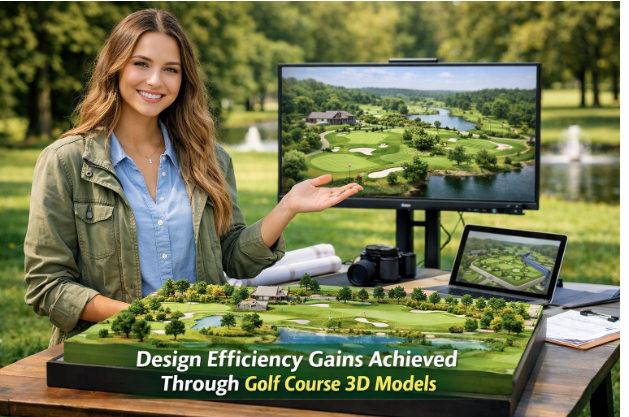
The design of a golf course is a complex process that requires a mix of creativity, constraints of land, playability, environmental factors, and feasibility of construction.
With the time for project completion becoming shorter and the need for accuracy becoming greater, inefficiencies in the design process are becoming more expensive. This has led to the application of golf course 3D as a solution to improve the design efficiency of golf courses.
With the capacity to interpret abstract concepts into measurable and visual environments, 3D-based workflows give designers the confidence to implement their concepts.
Minimizing Time to Interpret 2D Drawings
Conventional golf course design entails a lot of 2D plans, contours, and sections. Although these are correct, they are always subject to interpretation, particularly with regard to levels, slopes, and relationships.
The designers typically take a lot of time to translate the drawings to mental models before reaching a decision. This makes the process of iteration slower and also results in a possible risk of misunderstanding.
3D visualization helps overcome this friction by giving the designer a view of the land as it is in three dimensions. This helps the designer visualize the fairway, green, and land at the same time.
Faster Validation of Routing and Layout Decisions
One of the most labor-intensive parts of golf course design is routing. The analysis of how the holes move from point to point, and how the transitions happen, can take a couple of iterations in 2D.
The 3D environment enables designers to navigate around the course, analyzing routing. Problems such as transition routing, sightline hazards, or land use may be recognized more easily.
In active design, golf course 3D allows for quicker validation of routing ideas, which then leads to fewer revisions in the future.
Streamlining Feature Placement and Adjustment
Proper positioning of bunkers, greens, water hazards, and cart paths is required for strategy, aesthetics, and maintenance. In conventional approaches, even small variations in positioning may require a lot of redrawing and cross-checking.
3D design facilitates the efficient modification of features. One can modify features and assess the effect on visibility, slopes, and playability.
Having one 3D golf course model assists in avoiding duplication of effort because it acts as a reference point for all the stages of design.
Enhancing Collaboration Between Design Teams
A normal golf course project would involve the collaboration of a number of professionals, such as architects, shapers, engineers, and environmental consultants. Inefficiencies can occur because different groups of people may be working from different versions of the same set of drawings.
3D visualization provides a universal visual language. This means that all people in a team can see and talk about the same environment.
Clear visualization results in:
- More productive design meetings
- Consensus on changes at a faster pace
- More direct communication
What this means is that the more the collaboration improves, the more time will be saved.
Early Detection of Design Conflicts
Some of the biggest inefficiencies come from the design conflicts that emerge late in the process. Grading, drainage, or interaction issues that emerge late in the process can be expensive to fix.
3D visualization is one of the tools that can help put such conflicts at the forefront of the design process early on. Designers can determine whether there are steep slopes around greens, misaligned bunkers, or drainage issues.
Problems that could arise during the concept or schematic design stage can be resolved much more quickly and with less disruption than if they were to arise at a later stage.
Accelerating Iterative Design Refinement
Design is necessarily iterative, but inefficiency occurs when the iteration process is slow or cumbersome. In 2D design, the iteration process of evaluating alternatives may involve redrawing certain elements.
3D environments also make it easier to iterate. It is easy to quickly test different alternatives for grading, routing, or feature placement and see what happens.
Good iteration results in good design outcomes, and at the same time, it keeps the project momentum going.
Supporting More Accurate Design Decisions
Efficiency is not only a function of speed but also a function of decision-making. When designers have a clear understanding of spatial relationships and constraints, decisions are made with more confidence.
Assumptions are not required in 3D visualization. Rather than attempting to determine what a change would look like and how it would function, designers can simply see what happens.
This helps a great deal in avoiding the possibility of reversals or changes in the later stages, which are important sources of inefficiency.
Decreasing Reliance on Physical Site Visits
Although site visits are still considered important, overdependence on them may lead to the progress of design work being delayed, particularly in the case of off-site projects.
Realistic 3D environments enable designers to analyze terrain and layouts virtually between visits. This cuts the number of visits and allows more work to be done off-site.
Having the site conditions available digitally helps to facilitate continuous progress without any logistical delays.
Enhancing Coordination with Engineering and Construction Inputs
It is easier to attain design efficiency when the architectural intent is in smooth alignment with engineering requirements. There can be redesign or clarification work when there is a lack of alignment.
3D models assist designers in understanding the relationship between site grading, drainage, and infrastructure and design elements. This enhances coordination with the engineering department and minimizes changes in the final stages of documentation.
It saves time on several activities that will follow.
Supporting Presentation Without Rework
Design teams might be asked to prepare presentation materials. In the conventional method, this could include the preparation of graphics that are not dependent on design drawings.
The issue of duplication is not applicable in 3D models. The same model that is used for design refinement can also be used for presentation.
Platforms such as VueMyGolf ensure that this efficiency is maintained by providing a level of accuracy and visualization that is ready to be presented, thus allowing teams to present their progress without having to rebuild assets.
Improving Long-Term Design Workflow Efficiency
The efficiency achieved is not only in the project phase. The appropriate 3D models can be applied in the subsequent stages of design, construction, and renovation.
The design teams can benefit from the existing models and apply them to their designs rather than building models from scratch.
Supporting Sustainable Design Choices More Efficiently
Analysis of environmental impact and land use efficiency may require more than one analysis. 3D visualization assists the designer in analyzing environmental impact, land use efficiency, and land modification quickly.
This enables improved decision-making without hindering the design process.
Conclusion
With the complexity of golf course designs increasing, efficiency has become an important consideration for success, in addition to creativity. Golf course 3D has significantly enhanced the efficiency of golf course designs by minimizing the time required for interpretation, accelerating the iteration process, facilitating collaboration, and detecting conflicts early. Efficiency in golf course designs has been achieved through 3D design methods that enable golf course designers to work smarter and faster with less rework. Efficiency in golf course designs by accurate visualization has become an important requirement in modern golf course designs.
