
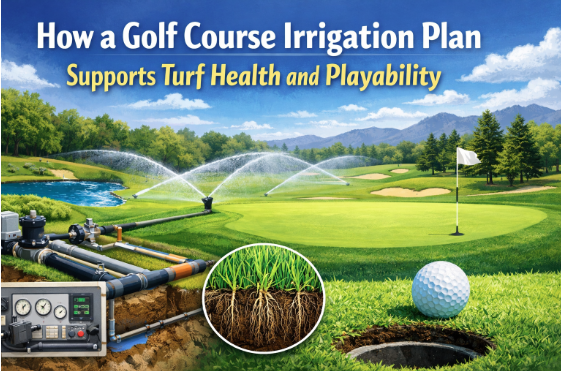
It is not an easy task to maintain healthy turf growth and playability on the entire course. There are so many factors such as soil type, elevation, sunlight, and usage that make the water requirements of the turf so extremely different in different parts of the course.
It is the golf course irrigation plan that is at the focal point of all this, but it is much more than a helpful technical plan, and can be a strategic golf course management tool that has a direct impact on turf growth, course performance, and maintenance.
Irrigation systems designed with planning and foresight can help to promote healthy root growth, good playing surfaces, and good playing conditions, irrespective of the season, but poorly designed irrigation systems can quickly result in poor turf growth, poor growth patterns, poor water use, and increased maintenance costs.
The importance of irrigation planning in promoting healthy turf growth and playability is discussed in more detail below.
Maintaining Healthy Turf Growth on the Entire Course
Healthy turf growth requires the right amount of water, at the right time, in the right places, and with proper consideration for the different needs of different areas of the course, any irrigation plan is much more likely to promote healthy, strong turf growth.
Too much or too little water will stress the grass; too much water will create moisture and algae, while too little water will weaken the grass and create pest problems due to stress.
A complete watering system will take into consideration all the external factors that may be affecting the course, and will adjust watering systems accordingly, to prevent too much surface water for longer-lasting grass, and to attract water to areas where it is needed at the right time. This will make a less chemical-intensive course and a healthy, well-balanced grass.
Accommodates Course Design and Topography
Golf courses are rarely flat, with changes in elevation, slopes, hazards, and water features all affecting the path of water on the land. Without careful and thoughtful planning, it is all too easy to create irrigation problems such as water pooling around lakes or running off slopes, which in turn damage the grass.
A complete course irrigation system plan will give course designers and superintendents an opportunity to choose sprinkler locations, pressure areas, and areas to water so that even the most difficult land can be irrigated.
Promotes Water Efficiency and Sustainability
As more and more golf courses are being asked to show their responsible use of water, irrigation plans are one of the easiest ways to meet this requirement. Select sprinkler patterns, nozzles, and zone sizes for maximum water efficiency, and use the latest technology, such as water sensors and weather data.
When a golf course uses water efficiently, both economic and environmental gains can be achieved quickly.
Aids in Maintaining the Course
Planning is a huge benefit to the golf course and its staff. Planning and documentation can help in speeding up problem-solving, make future upgrades simpler, and future repairs as easy as possible.
Selecting a reputable golf CAD company to help with irrigation planning will help ensure that all aspects of the irrigation system are well documented. Descriptions of how each irrigation system works can be explained in detail to professionals, and logical system design eliminates time and trouble during maintenance or emergency repairs.
Adapts Well to Seasonal and Weather Changes
Golf courses must operate regardless of the weather, and water usage patterns can change dramatically depending on the time of year, weather conditions throughout that year, the number of daylight hours, and whether the course is in a growth phase, dormancy phase, or a combination of both phases.
If the irrigation system is adaptable, then golf course managers can easily switch from one irrigation schedule to another without putting too much stress on the grass or wasting water. This will also help ensure that the grass is in the best possible health during the hot summer months as well as the cooler and wetter months.
A golf course irrigation plan requires a lot of investment and knowledge to ensure that your long-term maintenance costs are kept to a minimum. A golf course irrigation plan that is not well-planned may result in wear and tear, high maintenance costs, and rising water and energy bills. By giving the highest priority to proper fitting, placement, and integration of the golf irrigation plan drawings with the rest of the golf course, this investment is protected, and maximum savings are achieved.
Conclusion
The maintenance of healthy turf and playing conditions is not a question of luck or chance but a question of hard work and planning. A golf course irrigation plan that is properly planned will result in healthy growth because it provides the right amount of water, everywhere on the golf course, for the needs of that particular area, and at that particular time of the year. It provides equal playing surfaces, healthy root growth, a sustainable system that is environmentally friendly and saves money on maintenance, and is a godsend to the golf course maintenance staff. Proper golf course irrigation planning is the key to golf course superintendence.
