
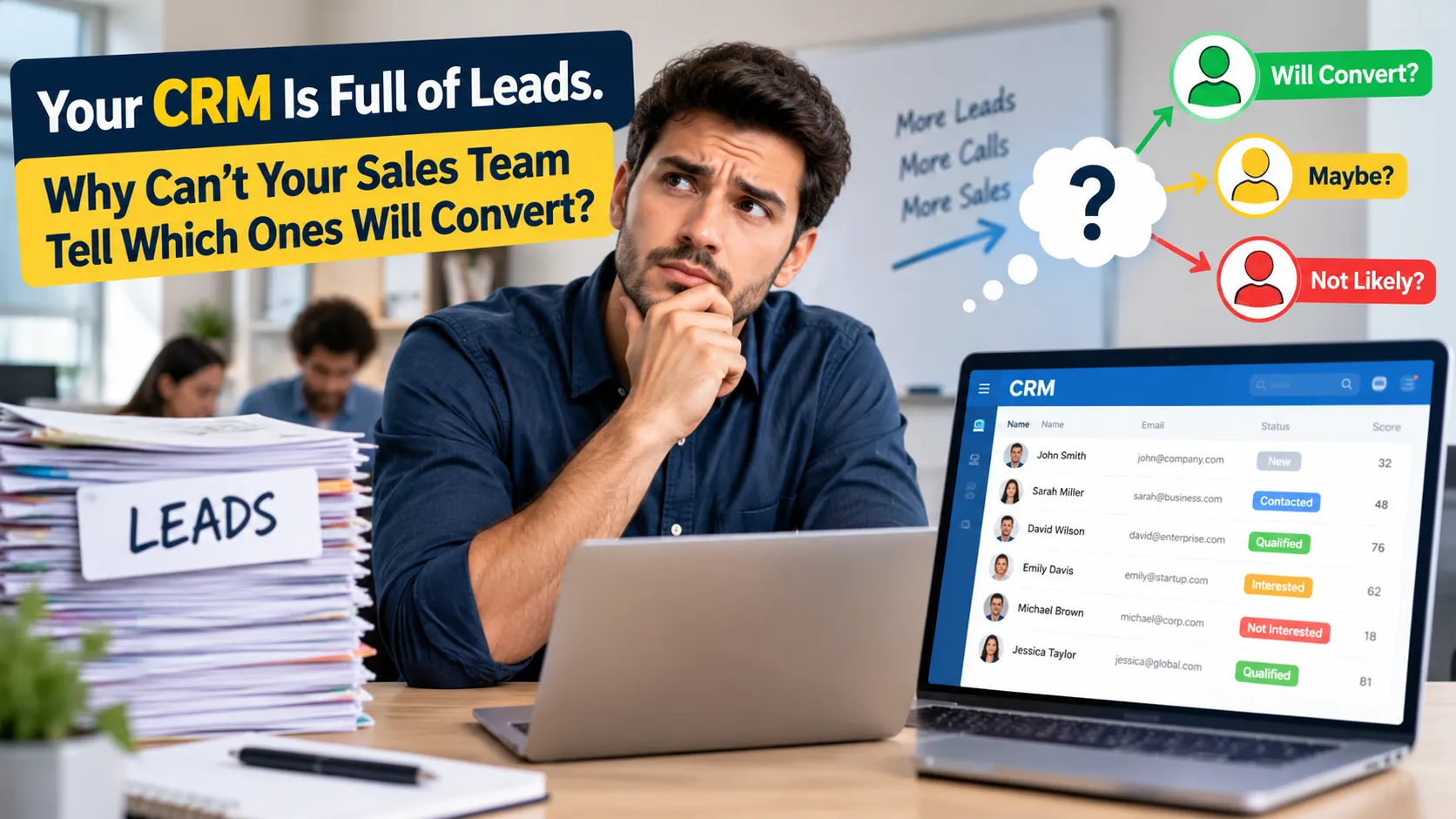
Your pipeline looks healthy on paper. Hundreds of leads, neatly logged, tagged, and scored inside your CRM. Yet every Monday morning, your sales team stares at that list and makes the same gut call they would have made without it.
If that sounds familiar, the problem isn’t your team’s instincts — it’s what your CRM is actually showing them. Most businesses investing in custom CRM software solutions assume that more data automatically produces better decisions. It doesn’t. It produces more noise around the same blind spot: your CRM records what already happened, but your reps need to know what’s happening right now.
Your CRM Is a System of Record — Not a System of Intelligence
CRMs were engineered as systems of record. They capture interactions, store contact histories, and log deal stages with consistency. What they were never designed to do is tell your sales team who is ready to buy today.
That distinction matters more than most revenue leaders acknowledge:
-
A system of record answers: what do we know about this lead?
-
A system of intelligence answers: what should we do about this lead right now?
Most CRMs are sold as both. They deliver only the first.
The misconception runs deep. Organizations invest in a CRM, populate it diligently, and conclude they now have a lead management strategy. What they actually have is a lead storage strategy. That’s a prerequisite — not a solution. The intelligence layer that turns stored data into prioritized action is entirely separate. For most teams, it simply doesn’t exist inside the tool they’re relying on.
Here is the operational irony: the more leads that enter a CRM, the harder prioritization becomes. Volume without signal hierarchy creates noise. Reps default to one of two biases:
-
Recency bias — working whatever came in last
-
Familiarity bias — working whatever their gut says looks closeable
Neither is a conversion strategy. Both are symptoms of a system that stores everything and illuminates nothing.
Why Signal Decay Is Silently Killing Your Conversion Rates
B2B intent signals have a half-life. A lead who visited your pricing page this morning is in a fundamentally different buying state than one who downloaded a whitepaper three weeks ago. Their CRM lead score may be identical. Their intent is not.
This is signal decay. And it is quietly destroying conversion rates across sales teams that believe their data is working for them.
Consider the scenario that plays out in almost every mid-sized B2B sales org:
-
A rep opens the CRM on Monday morning
-
200 leads sit in the queue
-
The strongest signal on the top-ranked lead is a webinar registration from 32 days ago
What does that score represent today? Not intent. Not readiness. It represents a moment of curiosity that may have already resolved — in a competitor’s favor.
The deeper misconception is that lead scores reflect buying intent. In most CRM configurations, they reflect historical engagement volume. Engagement and intent are correlated. They are not equivalent.
A lead who opened four emails is not the same as a lead who just returned to your case studies page after two weeks of silence. One shows your marketing reached them. The other signals something in their world has changed.
“Last Touched” Is a Sales Activity Metric — Not a Buying Intent Signal
“Last touched” metrics are among the most misleading columns in any CRM dashboard. They timestamp when a rep last took action — sent an email, logged a call — not when the lead last demonstrated genuine buying behavior.
This conflation carries a compounding cost. It rewards sales activity over lead readiness. Think about it this way:
-
A rep who sent a follow-up yesterday looks more engaged in the CRM
-
A prospect who visited the pricing page twice this morning isn’t even flagged
The CRM is measuring the wrong party’s behavior and calling it a conversion signal.
The Four Trigger Categories That Indicate Active Buying Intent
Genuine conversion intelligence isn’t built from email open rates and form fills. It’s built from live deal triggers — signals indicating a lead is inside an active buying window right now, not three weeks ago.
These signals fall into four distinct categories. Standard CRM configurations almost universally fail to surface any of them:
-
Firmographic triggers — funding announcements, leadership hires in relevant departments, mergers creating new operational gaps, or headcount surges signaling rapid scaling. These events create buying windows with defined timelines.
-
Behavioral triggers — a prospect who returns after 18 days of silence, downloads two case studies in a single session, then revisits the pricing page. No static lead score captures that sequence accurately.
-
Competitive triggers — public complaints about an incumbent vendor, G2 or Capterra review activity, or competitor contract renewal windows. These create natural switching moments.
-
Relationship triggers — a known champion inside a stalled account changes jobs. They carry institutional familiarity with your product directly into a new organization with fresh budget authority.
The governing principle across all four is straightforward. Conversion probability improves in direct proportion to how quickly a rep receives a signal after it fires. Delay is where deals die. Most CRMs are structurally built for delay.
Three Structural Changes That Turn Your CRM Into a Live Intelligence System
The solution is not a new CRM. It is a differently instrumented one. The system of record your team already uses becomes genuinely useful when a real-time intelligence layer is integrated directly into existing workflows. Signals should surface where reps already work — not inside a separate dashboard they’ll abandon within a week.
Three structural changes create this capability:
-
Connect verified intent data sources — Bombora, G2 Buyer Intent, or LinkedIn behavioral signals — directly into individual lead records. Trigger events should appear inside the CRM automatically. No separate platform login required.
-
Replace pipeline review cycles with trigger-based rep alerts. A rep should know when a signal fires. Not during Friday’s forecast call — immediately.
-
Retire static lead scores. Replace them with dynamic priority flags that carry expiration logic. If no new signal refreshes the flag within a defined window, the lead’s priority resets automatically.
Where Custom CRM Development Creates a Measurable Edge
Off-the-shelf CRM configurations are not built to handle real-time signal routing natively. The webhook logic, API integrations, dynamic field behavior, and expiration rules that make a live intelligence layer functional — all of it requires deliberate development work.
This is precisely where custom CRM software solutions create measurable competitive advantage. Rather than forcing a standardized platform to behave in ways it wasn’t designed for, custom development bridges the gap between your existing system of record and the live intelligence architecture your sales team actually needs.
The result is a CRM that doesn’t just store your pipeline. It actively works it.
The Core Problem Isn’t Lead Volume — It’s Moment Identification
Most sales organizations are solving the wrong problem. Building a better lead list, scoring it more accurately, ranking it more fairly — none of that addresses the core issue. Leads don’t convert because they ranked highly on a static list. They convert because a rep reached them at the precise moment their internal conditions aligned with an external solution.
That is not a lead prioritization problem. It is a moment identification problem.
The organizations pulling ahead aren’t the ones with the most leads in their CRM. They’re the ones whose systems surface the right signal, to the right rep, at the moment it actually matters.
Build a CRM That Works in Real Time — With Arobit
The gap between a full CRM and a productive one isn’t a data problem. It’s a timing problem. Leads don’t signal intent once and wait — they move through buying windows that open and close faster than any weekly pipeline review can track.
Arobit specializes in exactly that. As a trusted technology partner delivering top custom CRM software solutions, Arobit designs and develops intelligent CRM architectures that go beyond storage. The work includes:
-
Integrating real-time data layers into existing sales workflows
-
Building trigger-based alerting systems reps actually act on
-
Developing dynamic prioritization logic that reflects current lead intent — not last month’s activity
Whether rebuilding a legacy system or instrumenting an existing platform for live intelligence, Arobit brings the technical depth to close the gap between what your CRM knows and what your reps need to act on — right now.
Frequently Asked Questions
-
Why does a CRM full of leads still result in poor conversion rates?
Because volume and clarity are not the same thing. Without a mechanism to distinguish which leads are inside an active buying window today versus which ones engaged passively weeks ago, reps default to guesswork. The system stores interactions but cannot tell a rep whether a lead’s intent is live or expired. Conversion suffers not from a shortage of leads — but from an inability to identify which ones are ready right now.
-
What is signal decay, and why does it matter for sales prioritization?
Signal decay is the diminishing relevance of a lead’s engagement data over time. A pricing page visit carries strong intent signal in the hour it occurs. Three weeks later, that signal may be worthless — the lead may have already evaluated a competitor or gone cold. Most CRM lead scores don’t account for this. They treat a 30-day-old webinar registration with the same weight as a same-day return visit.
-
What are live deal triggers, and how do they differ from standard CRM engagement tracking?
Standard CRM tracking records marketing interactions — email opens, form submissions, content downloads. It measures whether your outreach reached someone. Live deal triggers measure whether something in a lead’s world has changed. A funding round. A leadership hire. A return behavioral session after weeks of silence. One tells you a lead exists in your database. The other tells you a lead is in motion. Converting at scale requires tracking the latter.
-
Do we need to replace our existing CRM to implement real-time lead intelligence?
No. Your existing system of record remains the foundation. What changes is the intelligence layer built on top — integrations, alerting logic, and dynamic field behavior that route live signals into existing rep workflows. This is a development and instrumentation challenge, not a platform replacement. Custom CRM software solutions bridge the gap between what your current system stores and what your sales team needs in real time — without the disruption of switching platforms entirely.
